Posts

Showing posts with the label The Little History of Aberdeenshire

Lockdown Day 30 – Fear and Loathing in Inverurie by Duncan Harley
Image
Boris got tough virus-wise on March 23, thirty days ago according to the Sun and same thirty days ago according to the Guardian. So that’s alright then. Thirty days to get used to lockdown and thirty days to find stuff to occupy the long days. No problem, I’ll write another book I thought. At maybe 2k words each day it should take at most forty days plus maybe another 10 days of formatting. Then add maybe ten editing days and ten more for subbing and more subbing. Trick with subbing of course is to spot grammar as well as spelling mistakes. Trick two – read it all backwards out loud from back to front. That’ll sort out the men from the buoys! Plus of course punctuation. Ok, make that eighty or so days. Or maybe 90 when you include proofing for accuracy, dates, timelines – we are talking non-fiction local history here! And, of course, the placing of images, creation of a cover plus some back-page. I could go on. Oh, and I need a willing graphic artist for that cover. The cover s...

Coronavirus Lockdown Day Seven – Molly names Man Pretty

Image
It was only by luck that I managed to drive off the screaming savages. Outnumbered some eighteen to one I was at first fearful for my very life. However, my fearsome appearance, plus the fact that I brandished a loaded rifle, proved sufficient to ward them off and I had only to scream back at them in my native tongue to startle even the boldest of them. ‘Awa ye go ye nasty wee radgies! Awa wi ye before I take this wee sharp blade and cut ye a Glesga smile and maybe perchance a new bum! Am no kiddin an at’s a fact ya filthy bunch o’ heathens!! Plus, a've got a big gun and you've no got one between the whole lot of you!' At this, the largest of the savages - a sheer giant of a man,  raised his club as if to counter my threatening tone. So, I instantly shot him through the throat and followed up with several facial thrusts of my dagger. He grinned widely and dropped down dead at my feet with blood spewing furiously from his wounds. It was a classic case of gaining domin...

Coronavirus Lockdown Day Five – I taste the goat and decide to re-visit the wreck

Image
I t is as I suspected. Today is almost certainly not Friday and yesterday was not Thursday. In fact, it was all a lurid dream brought on no doubt by remnants of that fever from which I am now mainly recovered. Or at least I think I am. And now of course, my priorities have changed. I am intent on taking to the sea again and am determined to return to my native Largo come what may. Meantime personal survival must be my focus. Alongside my need for potable water I will need a supply of meat to provide sustenance while I plan my escape from this island. And I now realise that the shooting of the feral goat was at best a jerk reaction and I now regret not having tamed and fattened the angry beast before firing that fatal shot. The corpse was at best thin and stringy. The meat was tough and my scurvy made chewing difficult. In short, the goat was not up to expectations. But since all now done and dusted, I cannot now make amends for my miscalculation other than to vow that next time...

Coronavirus Lockdown Day Four – I shoot the goat and rename the parrot

Image
When I awoke today at first light my fever had completely and miraculously vanished and, despite the rigours of the past few days, I felt able to eat and drink a little from my meagre store of salvaged provisions which consist mainly of a damaged water barrel and some soggy ships biscuits. The water however tasted brackish and even the parrot declined to take more than a beak full of wet biscuit. We must find more sustenance and soon! Also, in the cold light of day, I have decided that Gertrude is not a good name for a parrot and will henceforth address her, if indeed she is a she, as Molly. Quite what made me consider calling her Gertrude eludes me now that I am clearer in thought and I can only assume that it was down to my fevered state of mind. Mid-morning, I again scoured the beach for salvage and was pleasantly surprised to stumble upon an intact timber box containing what must surely be the first mates set of engraved pistols. Undamaged and complete with both flints and le...

Coronavirus Lockdown Day Three – I name the parrot and dream of Black Madonna

Image
It is now some three days since our ship ran onto that reef and I have become more accepting of the new situation. Later in the week I intend to visit the wreck in the hope of finding both victuals and perhaps a few more tools with which to secure my continuing survival. In short, I am feeling more positive - if such a thing is possible. And I feel much more hopeful regarding a return to some form of normality. That is, if such a thing is indeed possible given the quite extraordinary events of the past few days. The footprint in the sand continues to trouble me but I have, yet again, concluded that further investigation will have to wait at least until the back-end of the week. The hallucinations, which I thought had ended on day two, continue big-time and alongside shades of the Virgin Mary I am now seeing images of other long dead saints including the mysterious  Black Madonna. I obviously am quiet fevered and imagine that this may be the cause of this insanity. Soaked ...

Coronavirus Lockdown Day Two – I find an axe and some dry gunpowder

Image
Today I resisted the urge to return to the shipwreck, which still lies firmly on the reef just some hundred yards offshore. To say that I lacked the energy for the trip would not be completely accurate since in truth, the beach is littered with the washed-up remains of my fellow shipmates and through the lens of my telescope I was able to spot the shattered body of the ship’s captain still lashed to the foremast alongside the limp form of the ships dog. I confess I found this sight to be too much for my already overwhelmed senses and will hold off until the ghastly remains are claimed by the sea before venturing out to salvage what little remains on-board. In any case, there is ample treasure to salvage onshore. A washed-up wooden chest revealed a still dry supply of gun-powder and a tea-chest from the ships hold contained both an ample supply of flour and sufficient yeast to make a sourdough starter. Both items will I think aid my chances of survival. That is of course shoul...

MY LADY OF THE WILDERNESS - by Duncan Harley

Image
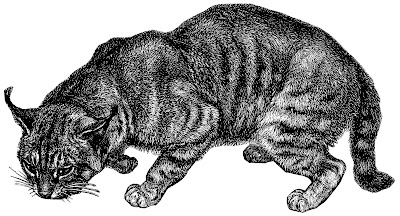
I am hugely relieved that the defamation action against Andy Wightman MSP brought by Wildcat Haven Enterprises has been settled in his favour. Mr Wightman had been pursued for damages of £750k following allegations that the conservation business had suffered loss due to his comments on social media and in his blogposts. Seemingly Lord Clark has ruled that none of Mr Wightman’s comments were defamatory and Mr Wightman has been quoted as saying that the action should have never have been brought against him. The Court of Session judge noted that Wildcat Haven was ‘engaged in a genuine scheme aimed at the conservation of wildcats run by well-intentioned and enthusiastic individuals. I have to wonder what all the fuss was about though - but I'm sure that all will eventually be revealed on Andy's blog @:   http://www.andywightman.com/ Here meantime, for what its worth, is an extract from chapter 11 of my recent book – The Little History of Aberdeenshire in which I...

ON THIS DAY IN 1898 – by Duncan Harley

Image
The planned township of Macduff has a relatively short history. As recently as 1759 the rent rolls for the settlement, known then as Down or Doune, recorded just 34 tenancies along with 400 inhabitants who subsisted through crofting and fishing from what was probably a very basic harbour. Today’s population is around 3850.  Burgh status came in 1783 and in that year, the first town council sat down to deliberate on the improvement of the burgh. Markets were licenced, vagrants were ostracised and residents forbidden to throw excrement and general rubbish onto to the streets. The Earls of Fife invested heavily in the town and encouraged improvements in agricultural practices. They clearly understood the potential of exploiting the natural resources of the sea and began harbour improvements in the 1760s. The harbour has been upgraded at regular intervals up to the present day, with ownership passing from James Duff, the second Earl of Fife, to the town council on March 1 1897, ...

BLOODY MONYMUSK - by Duncan Harley

Image
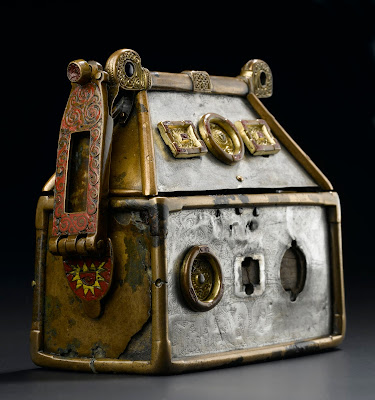
In the August of 2014 Edinburgh Auctioneers Lyon & Turnbull offered for sale a small decorative wooden box believed to be the work of Alexander J. Brook of Edinburgh silversmiths Brook & Sons. Brook was known for his meticulously researched reproductions of antiquarian items and the small (W 112mm x D 51mm x H 89mm) highly decorated, silver plated wooden casket would have presented few challenges for him. Brook’s 19th century replica was of an item known as the Monymusk Reliquary. The unsigned piece had been valued at between £5000-10,000 however, perhaps due to interest in all things Scottish generated during the run up to the Scottish Referendum and the approaching 700th anniversary of the Battle of Bannockburn, the tiny silver panelled yew wood container fetched a staggering £20,000 on sale-day. A strange prequel to the sale had of course been played out some 79 years before, in 1933, when the original Monymusk Reliquary had been advertised for sale by auction in a Lo...

BLOODY HARLAW – by Duncan Harley

Image
A special train left the Joint Station at Aberdeen on Friday 24 July 1914 and headed north to the old railway station at Inverurie where it stopped to pick up a number of very important passengers before proceeding to a point midway between Inverurie and Inveramsay. Wooden ladders were lowered onto the track and, on that damp and blustery pre-first-war summer’s day, some 300 passengers disembarked then trudged up through the muddy fields to join crowds of locals who had gathered to witness the inaugural ceremony of the monument to the July 1411 Battle of Harlaw. The battle is of course often portrayed as a simple bloodthirsty clash between Highland and Lowland cultures and popular belief holds that the outcome saved the city of Aberdeen from rape and pillage at the hands of the highland hordes. The Lord of the Isles was indeed a troublesome noble. He looked upon himself as legitimate heir to the Earldom of Ross and when the Duke of Albany, who had become Regent following t...

August 1918 - by Duncan Harley

Image
A young aviator from Inverurie was killed in combat over Arnaville on August 30 1918 age just 20. A lieutenant in the 55 th  Squadron of the newly formed RAF, he lies buried in a small village churchyard near where he fell to earth and is remembered on a family gravestone over at the Bass of Inverurie. An on-line tribute records that Thomas Laing, from Inverurie, Aberdeenshire, joined the fledgling Royal Air Force as a bomber pilot. In the April of that year, he went off to train at the flying station in Narborough, Leicestershire, where he learnt how to fly his two-seat biplane day bomber. He wrote to his parents every 4 to 5 days, describing the thrill of flying at high altitudes and finally qualifying as a pilot. On 14 August 1918 Laing went on his first flight behind enemy lines, bombing ground targets in Germany.  Just 16 days later he was shot down and killed. After his death, his mother received a letter from a girlfriend. It ends “I keep on remembering little thin...

A golden cigarette case – by Duncan Harley

Image
The original Don Bridge at Inverurie was completed by Banff mason James Robertson in 1791. Despite powerful floods and the ravages of time, the structure remained sound until the needs of 20 th   century transport forced its demolition to make way for the new crossing. The narrow roadway, plus the seven-foot-high central hump which vehicles had to negotiate had rendered the old bridge completely obsolete.  The contract for the new Don bridge was awarded to construction company William Tawse and, following the building of a temporary wooden crossing and demolition of the old bridge, construction of the new reinforced concrete bridge began in the April of 1924. A year later on the morning of 30 May 1925 an excited crowd of onlookers gathered to witness both the official testing and the official opening of the new bridge. At 10am precisely, a steam whistle blew and with a mighty roar two massive steam-driven road trains moved slowly in tandem onto the newly built ...

PLACE OF ORIGIN – by Duncan Harley

Image
The flight path into Aberdeen’s Dyce Airport offers spectacular aerial views of the Aberdeenshire landscape. Hills and lochs appear quite different when viewed from ten thousand feet and even familiar features, such as Bennachie, can take on a completely new and unexpected form. One such landscape feature is Place of Origin in the village of Kemnay. Conceived as a piece of landscape art and officially opened by HRH the Duke of Kent in 2006, the sculpture addresses the long and important history of granite quarrying in Aberdeenshire. In its heyday, the quarry at Paradise Hill employed 400 men with much of the quarried stone going to make iconic structures such as Sydney Harbour Bridge and Marischal College in Aberdeen. Ten years in the making, the Place of Origin artwork takes the form of a series of woodland walks and stone built features culminating in a high vantage point where visitors can appreciate the sheer scale of the old quarry workings within the surrounding ...

THE FAMOUS DIGGERS OF GEORGE SQUARE – by Duncan Harley

Image
George Square in Inverurie was built over several years by a town council intent on improving the local housing stock. Slum clearance was an issue and an enlightened group of councillors financed construction in the years prior to the Hitler war. The conflict of course intervened and it was not until the late 1940’s that the housing scheme was completed and fully occupied. Meantime Polish troops had occupied, and vandalised, some of the new-builds and a general rent-review had been agreed with slum-tenants from Constitution Street who had refused to move to the new-build properties on cost grounds. Oddly perhaps, the newly built housing scheme became a local icon for wartime self-sufficiency. Rationing during the early years of WW2 led to a dramatic increase in demand for agricultural land throughout the county of Aberdeenshire. Marginal land, parkland and golf courses, including the old course at Turriff, were sacrificed to the plough and fallow land was brought into use....

The Northern Lights of Old Aberdeen – by Duncan Harley

Image
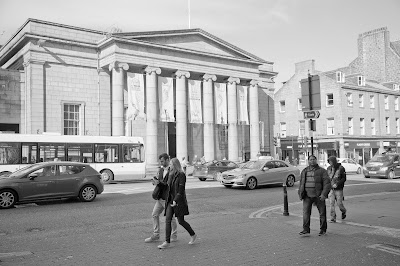
On 23 August 1989, Mary Webb’s ashes were scattered within the grounds of Kaimhill Crematorium at Garthdee. It's a fine place and worthy of a walk around. Mary however had actually been cremated at Oakley Wood Crematorium near Leamington during what Jack Webster recalls as “a brief and pathetic finale; few even in her own native area having the slightest idea of her significance.” So who was Mary Webb? When the Victorian era Aberdeen Music Hall closed for much needed renovations in 2016, a series of public events was organised during the weeks leading up to the closure. Titled ‘Lights Oot!’ the final performances showcased the diversity of the venue and celebrated the entertainments which had drawn the folk of Aberdeen and Aberdeenshire to the hallowed place over the years. Built to a design by architect Archibald Simpson the building opened in 1822, initially as a private membership only gentleman’s club, and over the intervening decades performers as diverse as Charles Dic...

Fair Trickit @ Aikey – by Duncan Harley

Image
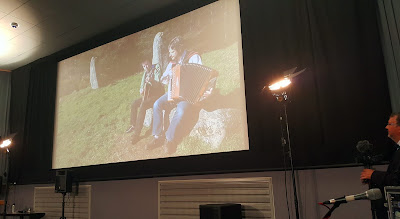
On July 2 1687 James II disbanded the English parliament, on the same day in 1900 Sibelius premiered Finlandia in Helsinki. July 2 1941 saw Noel Coward's Blithe Spirit premiered in London. And on July 2 1863, the participants @ the Battle of Gettysburg began a second day of bloodshed. Here in Aberdeen on July 2 2019 there were roadworks outside Robert Gordons and the Triple Kirks was bristling with scaffolding. The Belmont Cinema featured a few popular films and the first ever Doric Film Festival took place alongside the mainly Hollywood offerings such as Toy Story 4, The Queens Corgi and Boyle's Yesterday. Developed and presented by Frieda Morrison of Scots Radio fame it was a lively affair and, alongside some really splendid entries from schools, individuals and groups there were fine speeches from a variety of folk. I particularly liked the school entries and Meethill Primary headed the pack with a quite splendid docu-Doric take on the Bloo Toon.  Alongside the fi...

On This Day in 1964 – by Duncan Harley

Image
The Aberdeen typhoid outbreak began quietly on this day - May 16 1964 when two university students were admitted to hospital suffering from ‘pyrexia of unknown origin’. Further cases soon emerged and by the end of the epidemic a total of 507 cases had been confirmed including 86 children under the age of twelve. There were three deaths plus an additional eight linked cases treated elsewhere including one in Canada. By June 17 the epidemic was deemed officially over. A William Low supermarket in Aberdeen city centre was identified as being source of the epidemic and it was concluded that a 3kg can of Argentine corned beef had been the initial infective source. Argentine factories at the time routinely used untreated river as a coolant in the canning process and suspicion focused on the possibility of contaminated water entering through burst can seams causing bacterial contamination of the contents. The news of the epidemic was reported widely around the globe with one Spanish...

Air Raids and Sardines - by Duncan Harley

Image
It's amazing what you learn in a pub.  Although the Garioch town of Inverurie was never bombed during WW2 many, now elderly, survivors of those stressful days vividly recall being shepherding by  panicked primary school teachers towards the local bomb shelters when the air-raid siren sounded.  Coastal towns such as Fraserburgh and Peterhead bore the brunt of enemy air-action. Raiders from occupied Norway could make landfall over the Buchan ports, drop their bombs and make off over the North Sea well before fighters from airfields at Banff and Dyce were able to intercept them. The fishing port of Peterhead suffered at least 28 air raids during World War II with nearby Fraserburgh not far behind with perhaps 26 Luftwaffe raids. Retired railway engineer Joe Strachan recalls being in Peterhead visiting his auntie in 1940. “I must have been around eight or nine at the time. My aunt and my cousin panicked and I can vividly recall them jumping up and down on the double bed. ...

Mad, Bad and Dangerous to Know - by Duncan Harley

Image
There’s a splendidly spectacular circular hiking route around Gight over at Methlick. Known locally as the Braes of Gight, braes they certainly are. Plunging variously down some 300ft to the River Ythan and back up again this is not a walk for the faint hearted and for those more used to the gentle gradients of abandoned railway tracks the walk will fairly take your breath away. Of course, the essence of this trail is its association with the romantic poet, Lord Byron. Byron's mother was of course Catherine Gordon of Gight. ‘Mad bad and dangerous to know’, the poet and adventurer and 6 th Baron Byron died in April 1824 aged just 36 years. In a nod to the burial fate of the poet come artist come visionary William Blake (1757-1827), Byron was denied a final resting place amongst his literary equals at Westminster Abbey. Instead he lies buried alongside the 14 th century church of Mary Magdalene’s in Hucknall. Few, outside Aberdeenshire realise that he grew up in Aberdeen’s Br...