Posts

Showing posts with the label Bennachie

The Bailies of Bennachie – by Duncan Harley
Image
For my sins, I am now a Bailie of Bennachie. After writing about the hill range and the county of Aberdeenshire for a decade or so, I finally took the plunge and now have an official membership card plus a car window sticker to advertise the fact. The duties are of course minimal. I could perhaps volunteer for path work – but thankfully I am too old. I could maybe donate to the worthy cause – but unfortunately, I am too skint nowadays.  So, in the absence of a lottery win I will continue to support the cause by penning some more words about the splendid hill. In recent books and articles, I penned tales about the likes of Jock o’ Bennachie’s long bed over at Craigshannoch, Pilot Officer Lightfoot’s air-cannon and of course the bewitching Faeries at Hill Park who, according to Inkson McConnachie were particularly fond of playing sad tricks with the rustics. A favourite however is the tale of George Esson. He is buried over at Chapel of Garioch and was perhaps the l...

PLACE OF ORIGIN – by Duncan Harley

Image
The flight path into Aberdeen’s Dyce Airport offers spectacular aerial views of the Aberdeenshire landscape. Hills and lochs appear quite different when viewed from ten thousand feet and even familiar features, such as Bennachie, can take on a completely new and unexpected form. One such landscape feature is Place of Origin in the village of Kemnay. Conceived as a piece of landscape art and officially opened by HRH the Duke of Kent in 2006, the sculpture addresses the long and important history of granite quarrying in Aberdeenshire. In its heyday, the quarry at Paradise Hill employed 400 men with much of the quarried stone going to make iconic structures such as Sydney Harbour Bridge and Marischal College in Aberdeen. Ten years in the making, the Place of Origin artwork takes the form of a series of woodland walks and stone built features culminating in a high vantage point where visitors can appreciate the sheer scale of the old quarry workings within the surrounding ...

Easter Aquhorthies Stone Circle - By Duncan Harley

Image
The ancient standing stones at Easter Aquhorthies, on the outskirts of Inverurie, appear to have been chosen specifically for their colour. A mixture of red jasper and grey granite uprights sit alongside a humongous recumbent boulder quarried from the foot of nearby Bennachie. Described by Historic Environment Scotland as “An intact, recumbent stone circle consisting of eleven erect stones, the recumbent stone and three stones set almost at right angles to it, all set in a low ridge of small boulders” Easter Aquhorthies attracts a steady stream of visitors keen to touch the monoliths. Seemingly red jasper has spiritual qualities and, as a result, portions of some stones have been rubbed smooth over the centuries. This ancient Neolithic circle is, even nowadays, relatively complete and today attracts what unkind locals describe as ‘folk intent on watching the mid-summer dawn while performing fertility rights and Mother Earth ceremonies’. The circa four-thousand-year-old site is a...

Bennachie’s Casualties of War - By Duncan Harley

Image
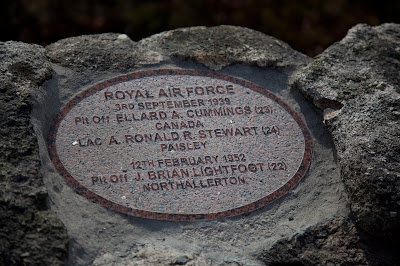
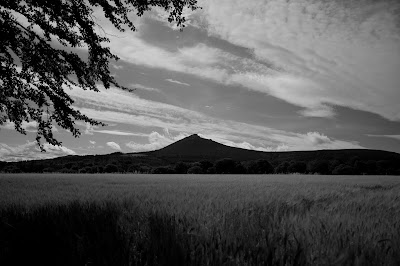
September 3 marks the  anniversary of the declaration of war in  1939 and, just a few hours into the conflict, the Bennachie hill-range in Aberdeenshire was witness to an accident resulting in the deaths of two RAF airmen. The hill has seen two 20 th century air crashes. The most recent in 1952 when an RAF Gloster Meteor jet fighter on a training flight from RAF Leuchars crashed during a snowstorm into Oxen Craig on 12 February 1952. The pilot, Yorkshireman Brian Lightfoot died instantly on impact and wreckage was scattered over a wide area. One of the aircraft’s cannon was retrieved by souvenir hunters and was for a time stashed in a barn over at Oyne before being re-discovered in the 1980’s. The RAF’s fleet of Gloster Meteors had what can only be described as a horrendous safety record and records indicate that there were 436 fatal accidents between 1944 and 1986. Some 890 of these aeroplanes were lost during that period over the entire UK including one piloted by ...