Posts

Showing posts with the label Don

A golden cigarette case – by Duncan Harley

Image
The original Don Bridge at Inverurie was completed by Banff mason James Robertson in 1791. Despite powerful floods and the ravages of time, the structure remained sound until the needs of 20 th   century transport forced its demolition to make way for the new crossing. The narrow roadway, plus the seven-foot-high central hump which vehicles had to negotiate had rendered the old bridge completely obsolete.  The contract for the new Don bridge was awarded to construction company William Tawse and, following the building of a temporary wooden crossing and demolition of the old bridge, construction of the new reinforced concrete bridge began in the April of 1924. A year later on the morning of 30 May 1925 an excited crowd of onlookers gathered to witness both the official testing and the official opening of the new bridge. At 10am precisely, a steam whistle blew and with a mighty roar two massive steam-driven road trains moved slowly in tandem onto the newly built ...

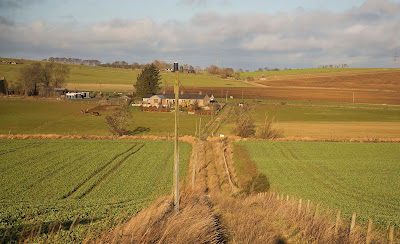
ARICULTURAL PROSPERITY IN ABERDEENSHIRE - by Duncan Harley

Image
Agricultural prosperity in Aberdeenshire owes much to the improvements in communication and transport brought about both by the Aberdeenshire Canal in the early 19th Century and the arrival of the railways in around 1850. For the first time, key agricultural inputs such as guano and the euphemistically named ‘night soil’ or inner city dung collected from population centres could be ploughed into the land. Movement of goods was key. And i n 1793 a survey was commissioned to map a route for a proposed Don and Urie-side Canal. The original thought had been to follow the courses of the rivers Don and Urie to link Insch and Monymusk with Inverurie and Aberdeen Harbour. There was even a suggestion that the water-network might include the settlements of Aboyne and Banchory. However, due to cost implications, a less ambitious route linking Inverurie to Aberdeen roughly along the line of the River Don was adopted. Officially opened in June 1805, the waterway featured 17 canal locks. Ther...

Fording the Urie – By Duncan Harley

Image
I visited Old Rayne today. Not my favourite place to be honest since it brings back difficult memories. I lived in the village some years ago and when forced by chance to drive past it, I tend to avert my gaze and block out ghosts. But no matter. Little did I know that some decades on from a trip across the water – well the River Urie actually – a blast from the past would come back to haunt me. Wiki informs that ‘The River Ury is a small river in North-east Scotland situated in the Garioch area of Aberdeenshire. Its origins are close to Bennachie, approximately 25 miles to the northwest of Aberdeen. The river runs for approximately 15 miles before meeting the River Don at the south edge of Inverurie.’ And that would be about right. Mind you I am unsure about that spelling since the Urie appears within many local books as Ury and the source of the Don tributary is subject of debate. It’s a powerful river, despite its size, and over many years the Urie has meandered at wi...

Walking @ the Braes of Gight

Image
We had a wee gander round Gight yesterday. The temperature hit the mid 20s and the boots trudged some six miles around a circuit known locally as the Braes of Gight. And braes they certainly are. Both Janice and I struggled to complete the circuit. Plunging variously down some 300ft to the River Ythan and back up again makes this not a walk for the faint-hearted and, as folks more used to the more gentle gradients of abandoned railway tracks and the like, it fairly took our breath away. Of course, the essence of this walk is the association with Byron. Not that I am an avid reader of his work; but I am drawn to the man on the back of that epithet ‘Mad, bad and dangerous to know.” With somewhat uninspiring opening lines such as “O Thou! who rollest in yon azure field”, “When energising objects men pursue” and “We do not curse thee, Waterloo!” it’s a wonder that anyone reads Byron nowadays unless forced by academic requirements or perhaps an overenthusiastic zeal for the days ...