Posts

Showing posts with the label history

ON THIS DAY IN 1898 – by Duncan Harley

Image
The planned township of Macduff has a relatively short history. As recently as 1759 the rent rolls for the settlement, known then as Down or Doune, recorded just 34 tenancies along with 400 inhabitants who subsisted through crofting and fishing from what was probably a very basic harbour. Today’s population is around 3850.  Burgh status came in 1783 and in that year, the first town council sat down to deliberate on the improvement of the burgh. Markets were licenced, vagrants were ostracised and residents forbidden to throw excrement and general rubbish onto to the streets. The Earls of Fife invested heavily in the town and encouraged improvements in agricultural practices. They clearly understood the potential of exploiting the natural resources of the sea and began harbour improvements in the 1760s. The harbour has been upgraded at regular intervals up to the present day, with ownership passing from James Duff, the second Earl of Fife, to the town council on March 1 1897, ...
ON THIS DAY IN 1638 – by Duncan Harley

Image
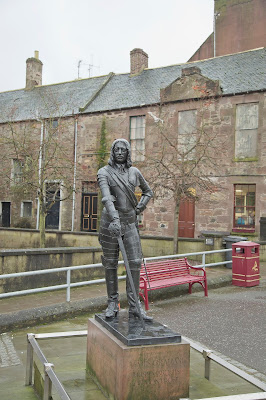
James Graham 1st Marquis of Montrose was born in 1612, probably on the High Street site now occupied by the local Job Centre Plus in the Angus town of Montrose.  He was one of the first to to sign  the National Covenant at Edinburgh on 28 February 1638. Outlining radical demands for change in Scotland’s governance, the Covenant led to a bloody civil war and would ultimately lead James Graham to the gallows. Following his sacking of Aberdeen in 1644, a portion of his army, led by Alexander Irvine of Drum, entered Montrose’s hometown with the intention of seizing the town’s two brass cannon.   Meeting local opposition, the Marquis’s troops destroyed the artillery pieces and plundered the town, before withdrawing north for fear of a counter-attack. In 1645, the Aberdeenshire town of Alford played host to what was perhaps the Marquis of Montrose’s easiest victory. After his defeat of Sir John Hurry’s forces, at Auldearn, in early May 1645, Montrose had confronted a ...

A golden cigarette case – by Duncan Harley

Image
The original Don Bridge at Inverurie was completed by Banff mason James Robertson in 1791. Despite powerful floods and the ravages of time, the structure remained sound until the needs of 20 th   century transport forced its demolition to make way for the new crossing. The narrow roadway, plus the seven-foot-high central hump which vehicles had to negotiate had rendered the old bridge completely obsolete.  The contract for the new Don bridge was awarded to construction company William Tawse and, following the building of a temporary wooden crossing and demolition of the old bridge, construction of the new reinforced concrete bridge began in the April of 1924. A year later on the morning of 30 May 1925 an excited crowd of onlookers gathered to witness both the official testing and the official opening of the new bridge. At 10am precisely, a steam whistle blew and with a mighty roar two massive steam-driven road trains moved slowly in tandem onto the newly built ...

Duncan Harley – An Interview

Image
Local history writer with two best-selling books under his belt, author Duncan Harley reveals all. Q: What inspired you to write about the history of north-east Scotland? A: A chance encounter with an employee of a publishing firm led to book one. As in so many things in life, it’s the little things that matter. I had been asked to review a couple of books for a glossy magazine and as a follow-on, sent some recent articles to test the waters. The articles ended up on an editor’s desk and two books were subsequently commissioned. Q: What inspired you to write your most recent book? A: The A-Z of Curious Aberdeenshire had a somewhat random structure and I felt that for book two, a historical timeline was really needed. Hence – The Little History of Aberdeenshire. I had attended a conference organised by Aberdeen Library Service in 2017 at which a local archaeologist had delivered a lecture about the Roman occupation of the north east and felt that Picts and Romans ...

McCombie's Black Prince - by Duncan Harley

Image
On 12 June 1878 a ponderously titled farming journal, The North British Agriculturist, published an article honouring Scotland’s ‘Cattle King’ - Mr William McCombie, of Tillyfourie. McCombie had, the previous Sunday, carried-off top honours for livestock at the Paris Exposition Universelle - better known perhaps as the Third Paris World Fair. “This is indeed a proud week for Tillyfour and for the polled Angus or Aberdeen breed of cattle … Mr McCombie having been adjudged the £100 prize for the best group of cattle, bred by exhibitor and reared out of France,” ran the article. “McCombie’s successful group numbered six animals…every black polled animal has a ticket of some kind!” Preparations for the Paris Exhibition had involved major upgrading of the French railway network, and it is fair to assume that McCombie’s cows had travelled in some comfort from Alford to Paris by train, before alighting at the delightfully named Gare du Champ de Mars, alongside the Eiffel Tower. The ...

D-Day minus Trump - by Duncan Harley

Image
The Normandy Landings, more commonly referred to as D-Day, took place on 6 June 1944. The term D-Day is of course military-speak for the jumping-off date for any military operation. Timed to the minute, large scale military interventions rely on precise timing in order to coordinate both the delivery of firepower and the delivery of the necessities of warfare. The D simply stands for "day" and the designation traditionally marks day one of manoeuvres. Thus, the day before June 6, 1944, was known as D-1, invasion day was highlighted as D-Day and the subsequent days are described as D+1, D+2, D+3 and so on. Today is 4 June 2019 so by definition we are now at D+27,391. Mind you, the 1944 invasion planning had begun some months if not years before and were it not for a break in the weather, the landings might have been delayed by weeks. But, apart from losing the element of surprise, the planning would simply have been delayed by D...

Biggles Flies North - by Duncan Harley

Image
A young aviator from Inverurie was killed in combat over Arnaville on August 30 1918 age just 21. A Lieutenant in the 55 th  Squadron of the Royal Air Force, he lies buried in a small village churchyard near where he fell to earth. An on-line tribute records that “Thomas Laing from Inverurie, Aberdeenshire, joined the Royal Flying Corps as a bomber pilot. In April 1918 he went to train at the Royal Air Force (RAF) station in Narborough, Leicestershire, where he learnt how to fly his two-seat biplane day bomber. He wrote to his parents every 4 to 5 days, describing the thrill of flying at high altitudes and finally qualifying as a pilot. On 14 August 1918 Laing went on his first flight behind enemy lines, bombing ground targets in Germany. 16 days later he was shot down and killed” After his death, Laing’s mother received a letter from his girlfriend. It ends “I keep on remembering little things he said and did. I just loved everything about him”. Along with the offi...

The Railway Through Insch - by Duncan Harley

Image
The Garioch town of Insch somehow managed to retain its railway station despite the re-shaping of the railway system following the Beeching Reports of the 1960’s and today provides rural commuters with fast access to the oil capital of Europe and in addition hosts a community run museum in the former ticket office. Insch Connection Museum, a Registered Scottish Charity, hold an extensive archive relating to Insch’s past.  The museum’s focus for 2016 was “Souters of Insch”, a family business once central to Insch’s economy. Trading in everything from fencing supplies to wedding presents, the Souter brand was instrumental in bringing both electricity and employment to the village and for over 90 years operated a popular general goods store on Commercial Road. The town today boasts an aerodrome, a manufacturer of landmine clearance machines plus a good selection of archaeology. It can also claim the distinction of being one of only a very few places in Scotland bombed by the Germa...

The Little History of Aberdeenshire - by Duncan Harley

Image
In 'The A-Z of Curious Aberdeenshire', I exposed readers to a random series of tales from the North-east of Scotland. Factual stories about The Beatles very first tour of Aberdeenshire, a resume of the career of sporting superstar Donald Dinnie and a startling description of the 1916 terror-bombing of the village of Insch by a 300ft long German Zeppelin sat side by side with mythological tales about the Maiden Stone at Crowmallie, the tomb of Eth the Swift-foot at Kellands and the mysterious mound of death at the Bass. My intention in this new volume is to provide the reader with a few more snippets from Aberdeenshire’s colourful history. I have succumbed to the temptation to re-visit some of the stories featured in my previous book and trust that I will be forgiven for expanding greatly on those tales. The Blenheim of Buchan, a full expose of the Aberdeen typhoid scandal plus an expanded tale of artist-priest Peter Anson’s life in the North-east are examples. Tales about...

Fifty Long Shadows – By Duncan Harley

Image
Writing the back-page fluff for a new book is both a pain and a pleasure. The publishers generally put out a pre-publication questionnaire some months before even a single word is placed on the final page. Well, not that final really since drafts more drafts and final drafts are likely to supersede the early content. So, ideas change and the final fluff might not resemble the initial hopeful words. Then of course there is the difficult issue of the title. Should it be ironic, reflective of some pun or simply be a play on some clever words such as ‘Here be dragons’ or ‘You should read this since it will make you cleverer than you were before’? I don’t really know. But what I do know is that the joy of holding the print in your grubby hand makes up for the hassle of getting into print and the lack of monetary rewards. Not many folks know this, but most books fail to make more than the cost of printing and sell just a few thousand copies or even less. At last week’s Ab...

Bennachie’s Casualties of War - By Duncan Harley

Image
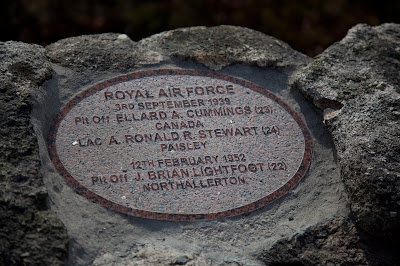
September 3 marks the  anniversary of the declaration of war in  1939 and, just a few hours into the conflict, the Bennachie hill-range in Aberdeenshire was witness to an accident resulting in the deaths of two RAF airmen. The hill has seen two 20 th century air crashes. The most recent in 1952 when an RAF Gloster Meteor jet fighter on a training flight from RAF Leuchars crashed during a snowstorm into Oxen Craig on 12 February 1952. The pilot, Yorkshireman Brian Lightfoot died instantly on impact and wreckage was scattered over a wide area. One of the aircraft’s cannon was retrieved by souvenir hunters and was for a time stashed in a barn over at Oyne before being re-discovered in the 1980’s. The RAF’s fleet of Gloster Meteors had what can only be described as a horrendous safety record and records indicate that there were 436 fatal accidents between 1944 and 1986. Some 890 of these aeroplanes were lost during that period over the entire UK including one piloted by ...

Curious Aberdeenshire

Image
Author Mike Shepherd  reviews Duncan Harley’s ‘ The A-Z of Curious Aberdeenshire: Strange Stories of Mysteries, Crimes and Eccentrics’ 'Tucked out of the way in the far reaches of the land, behold Aberdeenshire, a place that can boast the forlorn reputation of being largely unknown to the population at large. Edinburgh yes; Glasgow yes; and lots of tourists nip up the west coast of Scotland, but Aberdeenshire? If the area registers at all in the national consciousness, it’s a vague awareness of something to do with North Sea oil, whisky, farming and a bit of fishing. Otherwise nothing much ever seems to have happened there. Then along comes Duncan Harley’s new book to challenge these perceptions. Much in the way of odd and curious things did indeed take place in that north-eastern corner and the world hadn’t known about it until now. The book follows an alphabetic format starting with A for Aberdeenshire Art and ending up with Z for Zeppelins. Now that last se...

North East Scotland At War – by Alan Stewart

Image
Reviewed by Duncan Harley Five years in the making, Alan Stewart’s new book ‘North East Scotland At War’ will appeal to anyone even remotely interested in the history of the North-east of Scotland. There are plenty of home-defence books out there which record the difficult years between the Chamberlain peace accord and the Soviet conquest of Berlin. Osborne’s ‘Defending Britain’ and Gordon Barclay’s  ' If Hitler Comes’ are the classics. But this book is slightly different and there is certainly room for further historical accounts of the dark days when Hitler threatened our shores. With a decidedly local slant, North East Scotland At War launches the reader into the minutiae of the defence of the North-east against what was, for a brief few years, perceived as the Nazi threat. The archaeology of those distant times is laid bare and many of the official documents which record the difficult days inhabit the pages. A ground-based Invasion never came. But preparatio...

War and Peace in the Denburn Valley - A review

Image
In her book 'Aberdeen’s Union Terrace Gardens - War and Peace in the Denburn Valley'  author Diane Morgan explores the often turbulent history of one of the last of Aberdeen’s city centre green spaces. Opened to the public in 1897 and bounded by some of the city’s finest architecture, the Gardens have often been the subject of debate between developers intent on transforming the area to meet the needs of an expanding population and conservationists intent on retaining an irreplaceable asset. Dedicated to “all friends of Union Terrace Gardens” and profusely illustrated with both modern and historic images, the new book presents the complex and sometimes dramatic story of the Gardens from very early days right up to the present. Writing in her customary and easily accessible documentary style, Diane Morgan traces the early history of the Denburn Valley guiding the reader gently through the events and the politics which have shaped the manicured parkland which visit...

A Psychedelic Sweetshop and some Silver Beetles

Image
One of the pieces in my new book concerns the history of the early days of The Beatles. Not that I knew them or anything – although I did once meet an Elgin man who claimed that Paul played at his brother-in-law’s wedding -  but I have been privileged to both listen to the songs and I have of course visited a few of those local venues which – in those heady 1960’s – played host to the Fab Four. Now there’s a mouthful of words! There are of course many historical venues associated with the band and one of my favourites is Fraserburgh’s Dalrymple Hall. Billed nowadays as the Beatles ‘Lost Tour’ the 1960 tour included performances at Elgin, Bridge of Allan and Dingwall before climaxing at Fraserburgh. The stage at Dalrymple is on an upper floor of the building and leans towards the audience at some crazy angle or other. In the big scheme of things its surprising that performers, including bands and theatre groups, can remain completely calm whilst treading those illustrious boar...

Inebriated geese near the coastal town of Banff

Image
That’s the second edition of the book both printed and delivered to both my doorstep and of course to bookstores all around the globe. Hopefully this second printing will sell out just as fast as the first edition. I calculate that it took just a smidgeon over 2,467 hours and seventeen minutes to pen the book but only around 18 days for it to completely sell-out. Work out the math. The Amazon rankings seem to suggest that, for part of today at least, my book is number seven in the category ‘history, Scotland’ and number 44 in the category ‘folklore and legends, United Kingdom’. Well that can’t be bad surely. Mind you, the rankings change by the hour seemingly so I may be only a shining prince for a day. That shiny yellow Lamborghini looks to be within grasping distance, albeit in Dinky Toy format. As for the rest of today? Well I bought a chicken from a well-known supermarket outlet – ostensibly for my pet cat Lucy. It was only £2-10 and came already roasted. Not that I am parti...

New Books and Panties

Image
That’s the reprint done and dusted. Not that I had anything much to do with it. The whole point of having a publisher is after all to free up from the business of handling that end of the process. Not for me the ink-stained hands and the ear-shattering noise of the printing-press. Not for me the tedium of taking orders, invoicing them and shipping them to bookshops around the globe. And not for me the tedium of trying to actually get paid for my work. That is what a publisher does and, to date at least, The History Press seem well qualified in this regard. So, hopefully, those bookshops which have sold-out the first edition will shortly be selling out this second edition. Onwards and upwards etc. As for that header – New Books and Panties. Well it’s a not very successful play on Ian Dury’s debut album.  Wiki, and I am confident that they are right, says: ‘ Released in the UK on  Stiff Records on 30 September 1977. Usually thought of as the first album by Ian Dury a...

You must be Joe King

Image
Readers of my new book are maybe wondering why a good few of the images are credited to foreign museum sources. The Tryggve Gran chapter is a case in point. There are various archives which hold local images of his aeroplane at Cruden Bay. Sadly, however only the Norsk Tecknisk Museum in Oslo was kind enough to allow me a fee free image for inclusion in the book. Scottish sources wanted what they imagined was a suitable cut from my author’s royalties. In a similar vein, Museums Victoria in Melbourne were more than happy to source and then send me images of a James VIII silver guinea for inclusion on the basis that a photo-credit would be nice. I can respect that. I have of course met this sort of kindness before and it is of course very much appreciated. Balmoral Estates went to a lot of trouble to find me an image of Balmoral Castle and Fraserburgh Heritage Centre bunged me an image of Buffalo Bill Cody atop his white charger on the wild West Pier at Fraserburgh. All good and all...

Banksy-like Loyal Corrections by PK

Image
A loyal friend has subbed my work over the years. Alongside a good few splendid editors along the way, he has stuck by me for whatever reason and has often kindly suggested changes to my words. Banksy-like he is known only as PK, and has been kind enough to suggest changes to my recent book also. Sadly, and I say this smilingly, the book is almost sold-out and is on a fast-track to a re-print. February 8 is new publication day and Macmillan Distribution assure me that all outstanding orders will be fulfilled shortly afterwards. What a relief; and indeed, what an honour. And that’s great. Except, of course, the subbed text and the thankfully very occasional howlers will remain unchanged until the revised 3 rd edition which is due out sometime before summer. In the best possible taste and with a stereotypically familiar nod – whatever that may mean - to those, including Paul, who have pointed out the errors of my pen, here is a small selection of the corrections: ‘A-Z of Curious ...

A Good Hair Day

Image
Today was haircut day. The book is on reprint after all and even Waterstones are recording zero-stock. Plus, Deeside Books, a local Indie bookseller got in touch to say that they have none for sale at present. What could I say? Try Amazon wouldn’t quite cut the mustard – although the on-line giant seemingly still holds ample stock of my tome for delivery by 12pm tomorrow. Then there are the discounters. It appears that my barely four-week-old tome is available at a third off second-hand. Yeah right. But back to the haircut. I usually travel the 17 miles or so to the nearby town of Huntly around four times a year for a quick haircut plus a stroll around the bookshelves of yet another Indie store in the form of Orbs Community Bookshop. It’s a pleasant day out and comes with the bonus of a slap-up lunch at the local Asda. The barber, for that is what she is, is a pleasantly jolly lady who does an honest cut and does it well and speedily. On top of that, and this is important for me...