Posts

Showing posts with the label Insch

Arthur C. Clarke’s Mysterious World – by Duncan Harley

Image
Scattered across the Aberdeenshire hill-tops are a series of vitrified forts dating back to the Iron Age. While archaeologists struggle to understand the method of construction many oddball theories as to their origins abound. Supporters of the Ancient Astronauts theory believe that the vitrified ruins provide irrefutable evidence that death-rays created by superior outer space beings were used in ancient times to melt granite to form the defensive structures. Others believe that the fusion of solid rock was caused by bonfires lit as part of a religious ceremony or alternatively that fierce attacks by enemy tribes resulted in huge fires which caused the very rocks to melt. Detractors view the probability of the hill-top forts at Dunnideer or Tap o’ Noth remaining on fire long enough melt rock as unlikely commenting that this would have been “as near as the European Iron Age got to Las Vegas lit against the Nevada desert”. In an effort to solve the mystery, a full scale combu...
The Terror Bombing of the Garioch - by Duncan Harley

Image
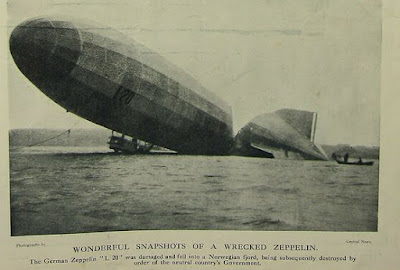
The editions of both the Aberdeen Free Press and the Aberdeen Daily Journal for Thursday May 4 1916 carried the news the war had finally arrived on Aberdeenshire’s doorstep in the form of aerial bombing by a German Zeppelin on the night of May 2nd. Headlines screamed “Terrific Noise of Crashing Bombs” and “Zeppelin at Rattray Head” alongside descriptions of up to 17 bombs having been dropped over the North-east in the course of the attack. Zeppelin raids were common over Southern England and the Continent but it had been assumed that North-east Scotland was well out of range of raiders, whose bases were around 12 hours’ flying time away in Germany. The usual targets for the German crews were naval and military bases, but in 1916, the art of night time bombing was uncertain at best, with many bombs falling on civilian areas. The airships mainly relied on navigation based on ground observation and bombs were often dropped by hand. There had been a raid on Scotland on 2 April ...

The Railway Through Insch - by Duncan Harley

Image
The Garioch town of Insch somehow managed to retain its railway station despite the re-shaping of the railway system following the Beeching Reports of the 1960’s and today provides rural commuters with fast access to the oil capital of Europe and in addition hosts a community run museum in the former ticket office. Insch Connection Museum, a Registered Scottish Charity, hold an extensive archive relating to Insch’s past.  The museum’s focus for 2016 was “Souters of Insch”, a family business once central to Insch’s economy. Trading in everything from fencing supplies to wedding presents, the Souter brand was instrumental in bringing both electricity and employment to the village and for over 90 years operated a popular general goods store on Commercial Road. The town today boasts an aerodrome, a manufacturer of landmine clearance machines plus a good selection of archaeology. It can also claim the distinction of being one of only a very few places in Scotland bombed by the Germa...

Runway 13 - By Duncan Harley

Image
Fatal aircraft crashes, often due to accidents in training, were fairly common in wartime.  Places such as Ballater, Aboyne and Logie Coldstone bear witness to the carnage.  In the October of 1943 for example, a Bristol Blenheim of 526 Fighter Squadron based at Inverness crashed on high ground at Morven. Both aircrew died. The pilot, a Welshman, was recorded as Flight Sergeant Douglas Evans and his wireless operator/air-gunner was named as Flight Sergeant Charles Baden from Derby. Another crash, this time of a Wellington bomber on a training mission out of Lossiemouth, occurred in 1942 high up in the hills behind Braemar. A gamekeeper out checking the deer herd at Glen Cluny eventually spotted the tail of the downed aeroplane sticking out of deep snow and alerted the local policeman. The eight aircrew had lain undiscovered for weeks and consisted mainly of New Zealander, Australian and American servicemen in training. Eventually, some 45 years after the tragedy, one o...