Posts

Showing posts with the label scotland

Piper Alpha - the 32nd Anniversary

Image
The Piper Alpha Memorial In Aberdeen Today - 6 July 2020, marks the 32nd anniversary of the Piper Alpha disaster in which 167 offshore workers lost their lives when a North Sea oil and gas platform caught fire 120 miles  northeast of Aberdeen.  Truly cataclysmic in scale, the tragedy marked a turning point in the oil and gas industry's sometimes cavalier attitude to health and safety. Lord Cullen, in his two-year inquiry into the tragedy, concluded that both engineering failings and a lack of basic safety protocol had led directly to the deaths. The Piper Alpha platform was said to be ageing, rusting and unstable and much was made of the claims by survivors that safety alarms were routinely ignored. In the light of the Cullen Report, health and safety law underwent major changes in the UK. Offshore survival training became mandatory and protective clothing compulsory. On top of that, offshore rigs nowadays are required by law to have quick escape routes to...
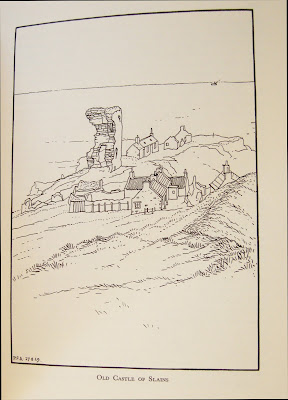

Same Old Slains – by Duncan Harley

Image
This lockdown situation has involved lots of changes. Social distancing, millions furloughed or working from home and more millions immersed in some bizarre governmental inspired Churchillian rhetoric dating from the 1940’s. Hopefully this time around we shall not be fighting in France. Bright lights on the horizon such as Sturgeon suggest that there may be an opportunity here to re-purpose and re-focus and I hope she is both correct in this assumption and correctly listened to. Anyway, not only am I in lockdown, but as of last week I am in something termed shielded lockdown. What does this mean? Well, I am part of an alien group who should avoid all human contact whatsoever just in case. Not that I currently have the virus, although I suspect I may have already had it some weeks ago, but just that I may get it – but nobody knows. Hence the enhanced shielding. Plusses? An offer of a weekly food parcel and priority access to supermarket delivery slots. I may take the powers tha...

Lockdown Day 30 – Fear and Loathing in Inverurie by Duncan Harley

Image
Boris got tough virus-wise on March 23, thirty days ago according to the Sun and same thirty days ago according to the Guardian. So that’s alright then. Thirty days to get used to lockdown and thirty days to find stuff to occupy the long days. No problem, I’ll write another book I thought. At maybe 2k words each day it should take at most forty days plus maybe another 10 days of formatting. Then add maybe ten editing days and ten more for subbing and more subbing. Trick with subbing of course is to spot grammar as well as spelling mistakes. Trick two – read it all backwards out loud from back to front. That’ll sort out the men from the buoys! Plus of course punctuation. Ok, make that eighty or so days. Or maybe 90 when you include proofing for accuracy, dates, timelines – we are talking non-fiction local history here! And, of course, the placing of images, creation of a cover plus some back-page. I could go on. Oh, and I need a willing graphic artist for that cover. The cover s...

Coronavirus Lockdown Day Eleven – What is there, what do we know, and how should we live?

Image
I am happy to report that Man March is much improved today. His mistreatment by those savages has left mental scars no doubt but his physical wounds were in fact minor. In fact, other than a fractured septum and some facial scratches he is generally fine and has even managed to exhibit what I can only take to be a smile. I must now attend to his broader education and, having begun to address his linguistic skills via a crash course in English as a foreign language, have also decided to educate him more widely with a view to developing his skills in critical thinking, analysis, clear writing, and some sustained but vital reflection on important philosophical problems, both contemporary and perennial, concerned with ethics, metaphysics, epistemology, language, logic, the natural and core social sciences, politics, aesthetics, and religion to name but a very few. To start with, I have set him a philosophical problem which few, if indeed any, European thinkers have been able...

Coronavirus Lockdown Day Eight – What did the chicken do?

Image
The parrot has become something of a problem. I have now recognised that, alongside my grammatical failings regarding the fiendish flesh-eating heathens whom I misconstrued as cannonballs Molly has been – dare I say it, taking the piss!   I put my cannibal error down to both exhaustion and to long and crazily confusing over-complicated sentence structures replete with ungrammatical asides and convoluted syntax infused as often as not with unstructured paragraphs replete with made up spelling rules and excessive and unnecessary-instances of hyphenation.  On-land I had a challenging sub-editor who would, for a favour, correct my syntax and my often-unintended attacks on the English language. Here, on this god-forsaken island there is not even a copy of the Abridged Oxford English Dictionary with which to bolster my prose! But back to Molly. The parrot has what I can only describe as a somewhat offbeat sense of humour. Her suggestion that we name my injured heathen ...

Coronavirus Lockdown Day Six – I stumble upon a dreadful sight and find potable water

Image
Mixed joy indeed! I have not only found a supply of potable water, but have by some strangeness of fate stumbled upon a dreadful sight.  I had, since early dawn, been heading inland via a narrow and quite steep wild animal trail when, just as the sun reached its zenith, I detected a familiar sound. I was at once paralysed with the fear that this was just some ghastly resurgence of those lurid and unwelcome hallucinations of yesterday. But as I approached the source of the noise my fears seemed without solid foundation. Before me lay a thin but quite stunning waterfall. A splendid stream of foaming water lay before me  and I immediately threw off my goat-stained apparel (remember the goat from day four of this pandemic?) and rendering some exited version of The Lord is My Shepherd  plunged into the foaming pool which lay beneath the thundering waterfall. My spirits were entirely lifted. I drank my fill from the tumbling waters and bathed completely naked in the clear...

Coronavirus Lockdown Day Four – I shoot the goat and rename the parrot

Image
When I awoke today at first light my fever had completely and miraculously vanished and, despite the rigours of the past few days, I felt able to eat and drink a little from my meagre store of salvaged provisions which consist mainly of a damaged water barrel and some soggy ships biscuits. The water however tasted brackish and even the parrot declined to take more than a beak full of wet biscuit. We must find more sustenance and soon! Also, in the cold light of day, I have decided that Gertrude is not a good name for a parrot and will henceforth address her, if indeed she is a she, as Molly. Quite what made me consider calling her Gertrude eludes me now that I am clearer in thought and I can only assume that it was down to my fevered state of mind. Mid-morning, I again scoured the beach for salvage and was pleasantly surprised to stumble upon an intact timber box containing what must surely be the first mates set of engraved pistols. Undamaged and complete with both flints and le...

Coronavirus Lockdown Day Two – I find an axe and some dry gunpowder

Image
Today I resisted the urge to return to the shipwreck, which still lies firmly on the reef just some hundred yards offshore. To say that I lacked the energy for the trip would not be completely accurate since in truth, the beach is littered with the washed-up remains of my fellow shipmates and through the lens of my telescope I was able to spot the shattered body of the ship’s captain still lashed to the foremast alongside the limp form of the ships dog. I confess I found this sight to be too much for my already overwhelmed senses and will hold off until the ghastly remains are claimed by the sea before venturing out to salvage what little remains on-board. In any case, there is ample treasure to salvage onshore. A washed-up wooden chest revealed a still dry supply of gun-powder and a tea-chest from the ships hold contained both an ample supply of flour and sufficient yeast to make a sourdough starter. Both items will I think aid my chances of survival. That is of course shoul...

ON THIS DAY IN 1898 – by Duncan Harley

Image
The planned township of Macduff has a relatively short history. As recently as 1759 the rent rolls for the settlement, known then as Down or Doune, recorded just 34 tenancies along with 400 inhabitants who subsisted through crofting and fishing from what was probably a very basic harbour. Today’s population is around 3850.  Burgh status came in 1783 and in that year, the first town council sat down to deliberate on the improvement of the burgh. Markets were licenced, vagrants were ostracised and residents forbidden to throw excrement and general rubbish onto to the streets. The Earls of Fife invested heavily in the town and encouraged improvements in agricultural practices. They clearly understood the potential of exploiting the natural resources of the sea and began harbour improvements in the 1760s. The harbour has been upgraded at regular intervals up to the present day, with ownership passing from James Duff, the second Earl of Fife, to the town council on March 1 1897, ...

ON THIS DAY IN 1638 – by Duncan Harley

Image
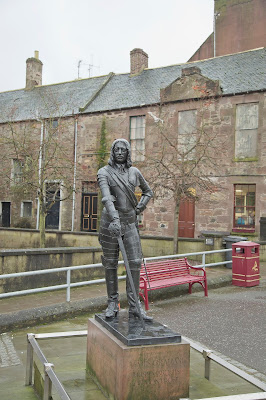
James Graham 1st Marquis of Montrose was born in 1612, probably on the High Street site now occupied by the local Job Centre Plus in the Angus town of Montrose.  He was one of the first to to sign  the National Covenant at Edinburgh on 28 February 1638. Outlining radical demands for change in Scotland’s governance, the Covenant led to a bloody civil war and would ultimately lead James Graham to the gallows. Following his sacking of Aberdeen in 1644, a portion of his army, led by Alexander Irvine of Drum, entered Montrose’s hometown with the intention of seizing the town’s two brass cannon.   Meeting local opposition, the Marquis’s troops destroyed the artillery pieces and plundered the town, before withdrawing north for fear of a counter-attack. In 1645, the Aberdeenshire town of Alford played host to what was perhaps the Marquis of Montrose’s easiest victory. After his defeat of Sir John Hurry’s forces, at Auldearn, in early May 1645, Montrose had confronted a ...

BLOODY MONYMUSK - by Duncan Harley

Image
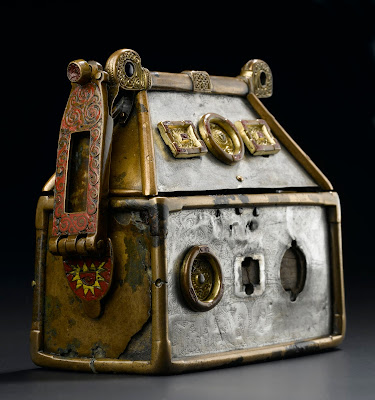
In the August of 2014 Edinburgh Auctioneers Lyon & Turnbull offered for sale a small decorative wooden box believed to be the work of Alexander J. Brook of Edinburgh silversmiths Brook & Sons. Brook was known for his meticulously researched reproductions of antiquarian items and the small (W 112mm x D 51mm x H 89mm) highly decorated, silver plated wooden casket would have presented few challenges for him. Brook’s 19th century replica was of an item known as the Monymusk Reliquary. The unsigned piece had been valued at between £5000-10,000 however, perhaps due to interest in all things Scottish generated during the run up to the Scottish Referendum and the approaching 700th anniversary of the Battle of Bannockburn, the tiny silver panelled yew wood container fetched a staggering £20,000 on sale-day. A strange prequel to the sale had of course been played out some 79 years before, in 1933, when the original Monymusk Reliquary had been advertised for sale by auction in a Lo...

BLOODY HARLAW – by Duncan Harley

Image
A special train left the Joint Station at Aberdeen on Friday 24 July 1914 and headed north to the old railway station at Inverurie where it stopped to pick up a number of very important passengers before proceeding to a point midway between Inverurie and Inveramsay. Wooden ladders were lowered onto the track and, on that damp and blustery pre-first-war summer’s day, some 300 passengers disembarked then trudged up through the muddy fields to join crowds of locals who had gathered to witness the inaugural ceremony of the monument to the July 1411 Battle of Harlaw. The battle is of course often portrayed as a simple bloodthirsty clash between Highland and Lowland cultures and popular belief holds that the outcome saved the city of Aberdeen from rape and pillage at the hands of the highland hordes. The Lord of the Isles was indeed a troublesome noble. He looked upon himself as legitimate heir to the Earldom of Ross and when the Duke of Albany, who had become Regent following t...

August 1918 - by Duncan Harley

Image
A young aviator from Inverurie was killed in combat over Arnaville on August 30 1918 age just 20. A lieutenant in the 55 th  Squadron of the newly formed RAF, he lies buried in a small village churchyard near where he fell to earth and is remembered on a family gravestone over at the Bass of Inverurie. An on-line tribute records that Thomas Laing, from Inverurie, Aberdeenshire, joined the fledgling Royal Air Force as a bomber pilot. In the April of that year, he went off to train at the flying station in Narborough, Leicestershire, where he learnt how to fly his two-seat biplane day bomber. He wrote to his parents every 4 to 5 days, describing the thrill of flying at high altitudes and finally qualifying as a pilot. On 14 August 1918 Laing went on his first flight behind enemy lines, bombing ground targets in Germany.  Just 16 days later he was shot down and killed. After his death, his mother received a letter from a girlfriend. It ends “I keep on remembering little thin...

The Bailies of Bennachie – by Duncan Harley

Image
For my sins, I am now a Bailie of Bennachie. After writing about the hill range and the county of Aberdeenshire for a decade or so, I finally took the plunge and now have an official membership card plus a car window sticker to advertise the fact. The duties are of course minimal. I could perhaps volunteer for path work – but thankfully I am too old. I could maybe donate to the worthy cause – but unfortunately, I am too skint nowadays.  So, in the absence of a lottery win I will continue to support the cause by penning some more words about the splendid hill. In recent books and articles, I penned tales about the likes of Jock o’ Bennachie’s long bed over at Craigshannoch, Pilot Officer Lightfoot’s air-cannon and of course the bewitching Faeries at Hill Park who, according to Inkson McConnachie were particularly fond of playing sad tricks with the rustics. A favourite however is the tale of George Esson. He is buried over at Chapel of Garioch and was perhaps the l...

A golden cigarette case – by Duncan Harley

Image
The original Don Bridge at Inverurie was completed by Banff mason James Robertson in 1791. Despite powerful floods and the ravages of time, the structure remained sound until the needs of 20 th   century transport forced its demolition to make way for the new crossing. The narrow roadway, plus the seven-foot-high central hump which vehicles had to negotiate had rendered the old bridge completely obsolete.  The contract for the new Don bridge was awarded to construction company William Tawse and, following the building of a temporary wooden crossing and demolition of the old bridge, construction of the new reinforced concrete bridge began in the April of 1924. A year later on the morning of 30 May 1925 an excited crowd of onlookers gathered to witness both the official testing and the official opening of the new bridge. At 10am precisely, a steam whistle blew and with a mighty roar two massive steam-driven road trains moved slowly in tandem onto the newly built ...

Bovine Population – by Duncan Harley

Image
You may have stumbled upon the writings of Melanie Reid of Spinal Column fame. Injured in an equine fall and now as recovered as she can be, she writes Notebook for The Times. And a good thing too. Always entertaining and always reflective she pens useful words. Today’s Notebook column leads with the economic disaster facing the Campbeltown Creamery. A farmer-led crowdfunding appeal has failed and the century old enterprise seems likely to close with both job losses and consequent effects for a west coast economy dependant mainly on fishing and tourism. In short, this end-game will have grave consequences for the 29 or so Mull of Kintyre farms who up until now routinely sent their milk for processing prior to shipment to the multitude of Tesco and Morrisons outlets up and down the land. She writes eloquently about ‘The ripples of human misery which accompany such change’ and states that ‘Scotland’s bovine population is at its lowest since 1957.’ I have no insight as to the sourc...

ARICULTURAL PROSPERITY IN ABERDEENSHIRE - by Duncan Harley

Image
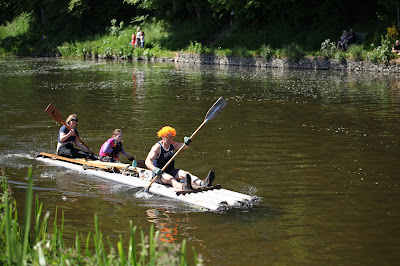
Agricultural prosperity in Aberdeenshire owes much to the improvements in communication and transport brought about both by the Aberdeenshire Canal in the early 19th Century and the arrival of the railways in around 1850. For the first time, key agricultural inputs such as guano and the euphemistically named ‘night soil’ or inner city dung collected from population centres could be ploughed into the land. Movement of goods was key. And i n 1793 a survey was commissioned to map a route for a proposed Don and Urie-side Canal. The original thought had been to follow the courses of the rivers Don and Urie to link Insch and Monymusk with Inverurie and Aberdeen Harbour. There was even a suggestion that the water-network might include the settlements of Aboyne and Banchory. However, due to cost implications, a less ambitious route linking Inverurie to Aberdeen roughly along the line of the River Don was adopted. Officially opened in June 1805, the waterway featured 17 canal locks. Ther...